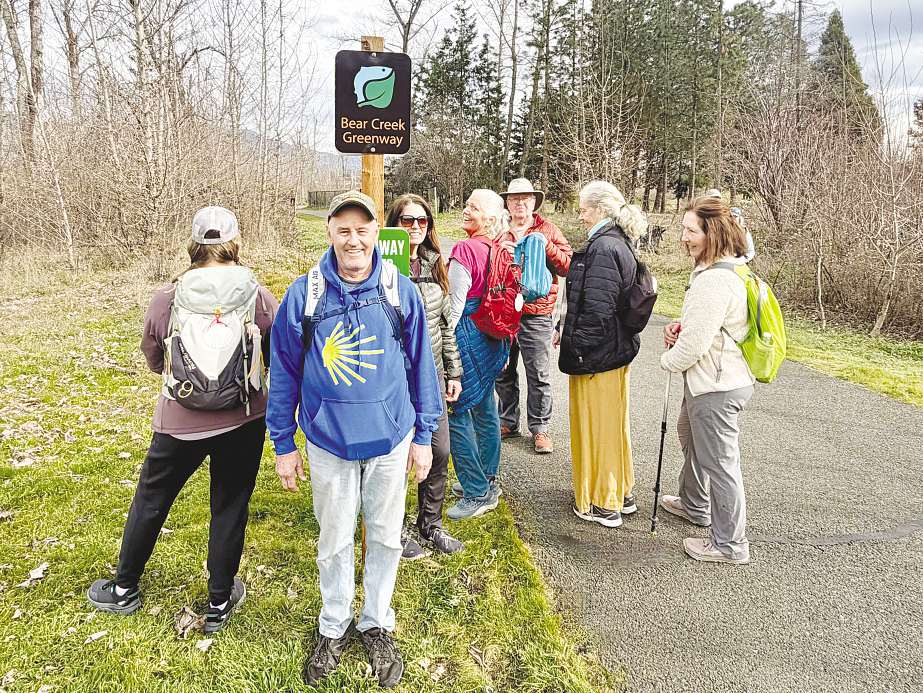
Terri Stefanson and Jzionna Gonzalez, standing under the sign, who are volunteers with the American Pilgrims on the Camino’s southern Oregon chapter, lead people in a training walk along the Bear Creek Greenway this month.
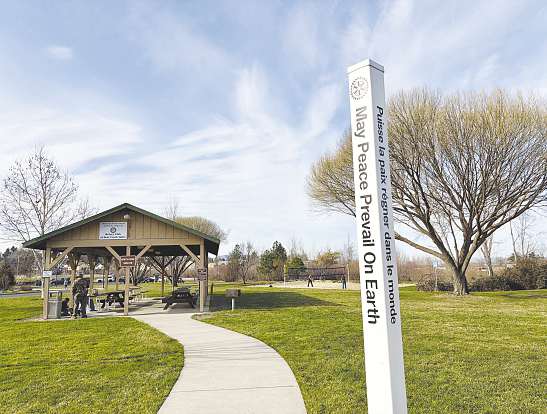
Peace Poles along greenways will point the way to the planned Oregon Peace Trail. The north-south route opens in spring 2027.


People walking in Oregon are seeing messages of peace. Over 1,000 wooden poles with “May Peace Prevail on Earth” in different languages are already standing in the state’s parks, greenways and other public places.
More Peace Poles are being installed this year by members of Oregon’s Rotary Clubs along a new route launching in 2027 called the Oregon Peace Trail.
Inspired by Spain’s famous Camino de Santiago, the Oregon Peace Trail is designed for people to be in nature, inviting relaxed conversations, listening and stretches of quiet contemplation.
The first 308 miles of the Peace Trail will connect the end of the Oregon Trail in Oregon City south to the World Peace Flame in Ashland.
“The Peace Trail, like the Camino de Santiago, is a walking meditation for deep reflection,” said artist and author Irene Kai, who established the continually lit World Peace Flame on Southern Oregon University’s Ashland campus.
Local Rotary clubs statewide will manage the Oregon Peace Trail, which will use existing paths. Day hikers and bikers can be on greenways and trails with firm surfaces and gentle grades that are wheelchair and stroller accessible.
There will also be quiet back roads for car and bus passengers, and people in kayaks, canoes, stand-up paddleboards and drift boats can float on the Willamette River Greenway and Water Trail.
Peace Pole wayfinding signs and a new app being developed will provide information on lodging, dining and area attractions, said Larry Strober of Lafayette, who came up with the idea of walks to empower peace building with fellow Rotary members Al Jubitz of Portland and David Wick of Ashland.
Like the network of Camino routes to northeast Spain’s Cathedral of Santiago de Compostela, organizers envision the Oregon Peace Trail expanding, eventually incorporating paths on the coast, along the Columbia River Gorge and all corners of the state.
Strober, who is the director of the Rotary Peace Pole Project, has been working on the Peace Trail idea since late 2024. He’s still refining the route for people of all ages to walk for peace, from a few steps to miles, while immersed in the beauty of Oregon.
Travelers will be able to collect a stamp in a trail passport from participating stops to commemorate their journey once the north-south route opens in spring 2027, said Strober.
There is a lot of work to do, but Strober, who wears lapel pins that read “Making a Difference” and “Create Hope in the World,” and other volunteers are undaunted.
“The world right now is not a very friendly place,” said Strober, 83. “Individuals can make a difference.”
Walking the Oregon Peace Trail
The initial route of the Oregon Peace Trail will follow, when possible, footpaths first carved by Indigenous people thousands of years ago.
The official northern start is the End of the Oregon Trail Interpretive & Visitor Center in Oregon City.
Corinne Lowenthal, executive director of Clackamas Heritage Partners, which manages the historic site, said people in wagon trains heading west on the Oregon Trail starting in the 1840s sought land and livelihood.
The Peace Trail “seeks community and understanding,” she said. It “invites participants to consider not only what pushed people westward, but also the consequences of that movement for Native communities and the shared responsibility that history places on us today.”
The southern Oregon route will include the existing 20-mile Bear Creek Greenway walking and biking trail, which runs from Central Point south through Medford, Phoenix and Talent to Ashland.
Some area residents who have hiked the Camino in Spain know the Bear Creek Greenway as the site of free training walks offered by the American Pilgrims on the Camino, a nonprofit organization based in San Francisco.
Last Saturday, Terri Stefanson and Jzionna Gonzalez, volunteers with the American Pilgrims’ southern Oregon chapter, were leading 10 hikers in a training walk along the Bear Creek Greenway.
The participants, outfitted with sun hats, backpacks and hiking shoes, talked about their past and future walks on the 1,200-year-old Camino de Santiago.
In 2025, more than 530,000 people completed a Camino route, either in one continuous journey or in sections over time, according to the American Pilgrims organization.
Hundreds of thousands more people from around the world were on some part of the Camino’s many paths, guided by yellow arrows and signs that include a scallop shell.
A Camino-like experience allows people who may not know each other to talk about how they feel, said Stefanson, who lives in Medford and will start her 10th end-to-end walk on the Camino this spring.
“It’s powerful and emotional,” she said. “It’s not just the people who are on the route at the same time but the people who have walked there in the past and will walk there in the future.”
The local Camino group on the Bear Creek Greenway passed by a Peace Pole installed last year by the Bear Creek Valley Rotary Club in Phoenix’s Blue Heron Park.
Teaching peace Peace
Poles were first installed by Rotarians over a decade ago. Eight years ago, Kai brought a World Peace Flame to Ashland. The Oregon Peace Trail is uniting these missions.
“Restoration is needed for the land, for each other, for healing. We are going to inspire each other and to do what is right and to see each other as relatives.”
IRENE KAI Brought a World Peace Flame to Ashland, Ore.
The World Peace Flame, encased in glass at the base of an obelisk at Southern Oregon University’s Thalden Pavilion, was lit Sept. 21, 2018, on the International Day of Peace and serves as a “beacon of light for all humanity,” said Kai.
After moving to Ashland almost three decades ago, the Chinese-born Kai discovered her ancestors were from the same village, Taishan, as Chinese railroad workers in Ashland who, in 1887, completed the final part of a continuous rail circuit around the United States.
Kai said Ashland’s World Peace Flame, “the iconic symbol of peace, unity, freedom and celebration,” honors Indigenous people and immigrants who helped the country despite discrimination, restrictions and racist laws.
“Restoration is needed for the land, for each other, for healing,” Kai said. “We are going to inspire each other and to do what is right and to see each other as relatives.”
The first Peace Trail route through Oregon will have seven sections, each dedicated to an action empowering people to be peace builders.
These actions are based on the online Peace Game process, which is part of the organization’s Peace on Earth by 2030 initiative.
Strober said the Oregon Peace Trail was created in November 2024 after he played the Peace Game with team members Jubitz, cofounder of the Rotary Action Group for Peace, and Wick, past president of Rotary E-Club of World Peace.
In April, Rotary members will host a peace event in Spain. They plan to commit to planting 100 Peace Poles along Camino de Santiago routes over the next three years, said Jubitz.
His family’s Portlandbased Jubitz Family Foundation has been funding Peace Pole projects in Oregon since 2017 and sees the Oregon Peace Trail as a “joyful, healthy way” to boost local economies and bring people together.
“People across the planet are crying for peace,” said Jubitz. “Everyone is tired of the violence.”
Give your input
People with route suggestions and businesses that want to participate can contact the local Rotary Club in northern Oregon’s District 5100 or southern Oregon’s District 5110, or Larry Strober at lsstrober@gmail.com.