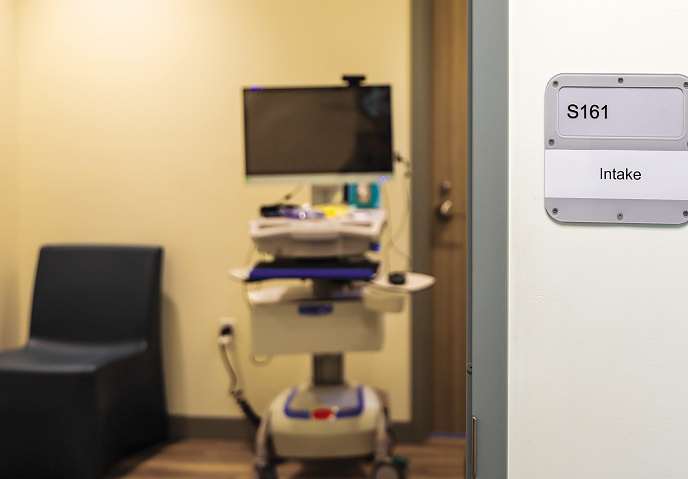
An intake room at Connections Kirkland, a check-in, 24-hour walk-in crisis care center in Kirkland. The center, which opened Aug. 10, is the first of its kind in the county.



Three months after a new walkin center for people in crisis opened in Kirkland, its operators say things are running smoothly, but it’s served fewer patients than expected.
Connections Health Solutions hoped the center, which offers immediate mental and behavioral health help to anyone who needs it, would serve up to 14,000 adults per year. In the first three months, it’s served just over 500, said Joel Conger, president of Connections West.
“What we’ve noticed here is that there’s a pretty well-established behavioral health fabric,” Conger said.
“We’re trying to figure out, how do we fitin? Not only are we this new organization to Washington, we’re bringing this new model.”
Connections, a private behavioral health company based in Arizona, is still working to spread the word to the public and build relationships with first responders who can refer people to the center. And as King County plans to open five centers with the same model, the Connections center provides relevant lessons about introducing a new type of care to the community.
“Just because we put a place here and we open the doors, that doesn’t necessarily automatically mean that folks are going to come and take advantage of it,” Conger said.
Inside the center Kirkland’s center — the first of its kind in the county — opened its doors to the public on Aug. 10 with fanfare from public officials.
State and local leaders say the center fills gaps in a mental health care system that doesn’t have enough beds and is inaccessible to many.
Right now, people in crisis often end up in hospital emergency rooms or jail, or they don’t get help at all.
The center includes an urgent care clinic, an observation unit where people can stay for up to 23 hours, and 32 beds for patients to stay up to 14 days before being discharged or referred elsewhere.
Anyone can walk in to receive mental health care, regardless of insurance status or ability to pay.
On a recent Friday afternoon, the lobby was quiet.
Most patients so far have been walk-ins, Conger said, primarily from the Eastside but also from as far away as Wenatchee or the Olympic Peninsula. Many have been enrolled in Medicaid, and some are completely uninsured.
A separate back entrance allows for direct drop-off from law enforcement, ambulances or mobile crisis teams. Connections is still working to build relationships and help emergency responders understand that the center is an option for patients in crisis, Conger said. In Phoenix, where Connections runs a center with the same model, about 60% of patients come from law enforcement drop-offs.
“That’s a great thing for so many reasons,” Conger said.
“It helps law enforcement do law enforcement stuff and not have to navigate the health care system.
That’s one of the areas that we really want to continue to focus on here.”
Three patients sat in reclining chairs in the spacious 23-hour observation unit while staff watched from a central glass “bubble.” That’s fewer than usual, said Dr.
Kyle Jasper, the center’s medical director; at times they’ve had 12 or 13 patients in the observation unit out of the 32 chairs available.
“Our observation unit is very much like an emergency room,” Jasper said. “There may be a seasonal trend to it, there may be a time-of-day trend, there may be a day-ofthe-week trend that we’ll start to learn over time as to when it gets busier versus when it’s a little slower.”
Around 60% to 70% of patients so far have been discharged after 23 hours of observation, Jasper said. The goal is to get patients to the least restrictive treatment setting — which might be outpatient treatment at a community mental health center, or outpatient psychiatry or therapy — once medical staff deems them ready and creates a clear treatment plan.
Upstairs, secured inpatient units house patients for both voluntary and involuntary treatment. On the voluntary side, nine of 16 beds were full; on the involuntary side, 11 of 16 beds were full.
The average voluntary stay is seven days, Jasper said, although patients can stay for up to 14. Involuntary stays tend to be a bit longer as patients go through the legal process to be involuntarily committed. The center has a conference room-sized courtroom equipped with videoconferencing technology so patients and providers can go to court without leaving the building.
If patients need further care after 14 days, Connections will file a longer-term inpatient hold through the court system and find another facility with available beds to transfer them to. This hasn’t happened yet, but Connections would consider transferring patients to Navos’ inpatient psychiatric facility in West Seattle or the University of Washington’s long-term civil commitment beds, Jasper said.
Future plans
The Connections center’s model mirrors the plan for King County’s five crisis care centers, funded by a $1.25 billion property tax levy voters approved in 2023.
It’s not yet known whether the Kirkland center will ultimately be one of the county’s five sites. In late September, the county opened applications for behavioral health agencies interested in running a center. Connections has submitted a letter of intent to apply as a “launch ready” site, meaning it could provide clinical services soon after being selected, Conger said.
The county will award contracts in January to agencies that are “launch ready.”
Another round of contracts will be awarded in June, for new site operators that will need to develop new facilities.
The county now anticipates the first center could open in 2025, a year ahead of the original timeline. All five centers are expected to be open and operating by 2030.
The levy divides King County into four crisis response zones, which will each host one center. A fifth center will specialize in serving youth. The plan requires sites to have “meaningful access to public transportation” and proximity to major arterial roads.
If Connections is selected as one of the centers, it would serve the North Zone, stretching from Shoreline and Lake Forest Park all the way east to Stevens Pass.
Connections has had to adapt to Washington’s involuntary commitment laws, which differ from Arizona’s, Jasper said. The center has also adjusted its protocols to be able to accept patients who have been given the overdose reversal drug naloxone by paramedics or firefighters.
The biggest takeaway so far, though, is the need to get word out in the community and build closer relationships with first responders and hospitals.
“This facility does a lot of things, but I think the thing it can do really well is it can be an alternative to the emergency room,” Jasper said. “I want facilities like this to be the place that people first think about bringing someone that’s in a mental health crisis.”
Taylor Blatchford: 206-464-2280 or tblatchford@seattletimes.com
We’d like to hear from you
The Mental Health Project team wants to know what questions you have about mental health and which stories you’d suggest we cover. Get in touch at mentalhealth@seattletimes.com.
About the project
The Mental Health Project is a Seattle Times initiative focused on covering mental and behavioral health issues. It is funded by Ballmer Group, a national organization focused on economic mobility for children and families. Additional support is provided by City University of Seattle. The Seattle Times maintains editorial control over work produced by this team.