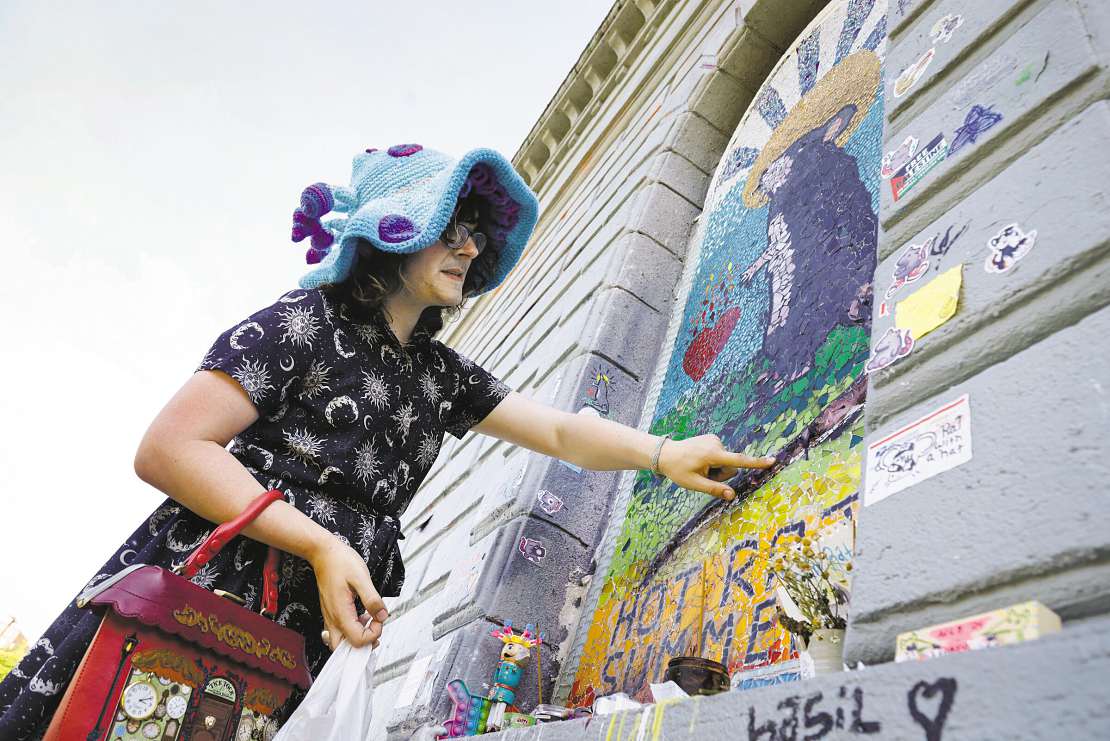
Cyanasen Azur is the “unofficial janitor” of the “Hot Rat Summer” mosaic. Azur, who is trans, said it wasn’t a surprise that residents of Capitol Hill, long a center of the city’s gay and transgender community, felt a kinship with the rat, an animal she said many tend to misunderstand.
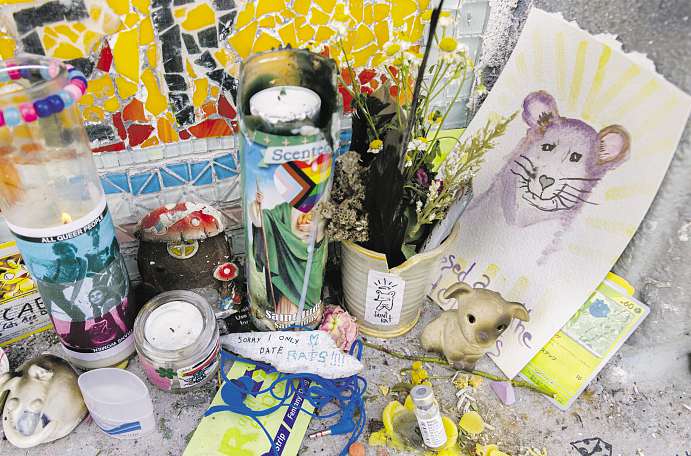
Visitors often leave offerings to “Saint Rat,” the star of the mosaic in Cal Anderson Park.
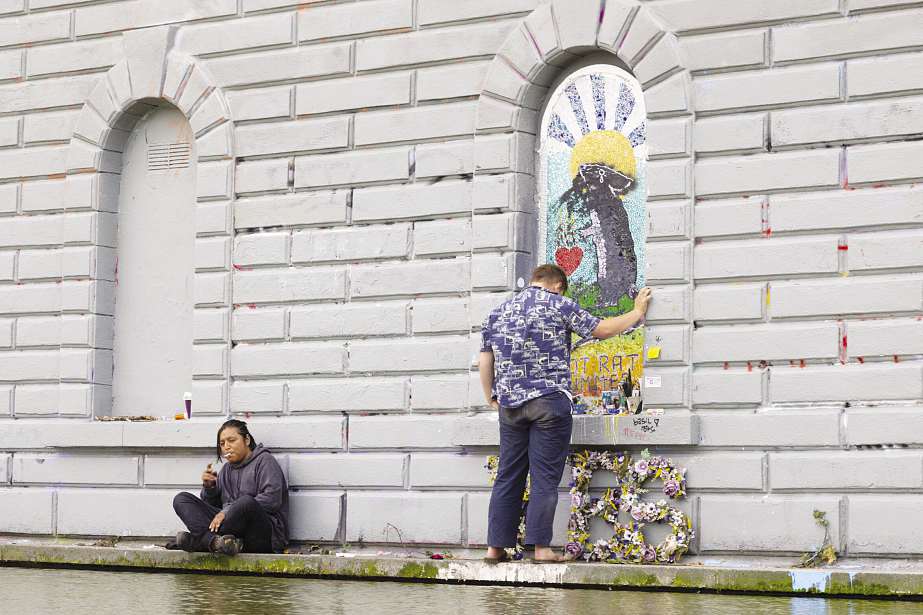
Numpa Bald Eagle smokes a cigarette as Alexander Dean looks over offerings left at the “Hot Rat Summer” mosaic, guerrilla art at Cal Anderson Park that many want to protect.


IT took Seattle artist Aaron Freedman and one friend some scraper tools, a jug of Citristrip gel and about four hours under the cover of a dark March night to liberate the giant, glittering rat at the heart of Cal Anderson Park.
Freedman felt he was unveiling something special as he scraped gray paint off the mosaic, from its narrow black tiles spelling the words “Hot Rat Summer” to its blue, white and pink stripes of the transgender pride flag.
But Freedman didn’t know that within weeks, the colorful mosaic that had lain mostly dormant for almost a year in Seattle’s Capitol Hill neighborhood would become a symbol of resilience for the city’s transgender community, inspiring a fervent, almost religious devotion from those who found a “patron saint” in the guerrilla artwork’s star: a halo-adorned rodent dubbed “Saint Rat.”
Freedman also didn’t know the artwork would test Seattle’s legal definition of graffiti, pressing City Council members to protect the illicitly placed artwork, even as they voted July 15 to impose harsher penalties on graffiti vandals.
The future of “Saint Rat” is now in limbo as city officials try to find a way to make permanent an artwork whose creators have not identified themselves or come forward to collaborate with the city on how to protect their work.
With no clear path forward, two City Council members and a group of residents have become makeshift stewards of the unexpected landmark. All agree they want the mosaic to stay, and ideally see more art added to the defunct gatehouse at Cal Anderson. But they disagree on how to best accomplish their goal.
Councilmembers Joy Hollingsworth and Alexis Mercedes Rinck have supported protecting the artwork, including getting Seattle Public Utilities and parks department workers to stop painting over it until they find a permanent solution.
They are also brainstorming ways the city can better support guerrilla artists, including creating designated public “community walls” where people could place their work without getting approval from the city in advance, and potentially changing the city’s “antiquated” definition of graffiti, Hollingsworth said.
But residents like Freedman say these efforts ignore the subversive nature of guerrilla art, a way artists express themselves, and their communities, on their own terms. And as long as people face arrest or fines like the new $1,500 graffiti penalty the City Council approved in July, Freedman said creators like those behind “Hot Rat Summer” will likely continue working in the shadows.
“It’s opened up a lot of discourse on public art and graffiti and how public art can define the culture of the city,” said Freedman, 30, who runs an unofficial Instagram account for the mosaic.
“Trying to enforce a policy or a process by which art can be deemed art misses the point entirely.”
Sense of kinship
Freedman first spotted “Hot Rat Summer” last summer, nestled in one of the north-facing false windows on the concrete gatehouse at Cal Anderson Park. The mosaic, composed of hundreds of meticulously placed tiles, appeared modeled after depictions of saints often seen in the stained glass windows of a cathedral.
The mosaic is most famous for its star, a giant, halo-wearing rat with its nose tipped toward the heavens and its tail curling through waves of multicolored grass. A flaming sacred heart floats beyond the rodent’s outstretched paws, and the words “Hot Rat Summer” appear under its feet, just above the transgender pride flag.
While Freedman doesn’t know who created the mosaic, he said it was clear the work was crafted by professional artists or tile workers.
“The fact that it’s remained so resilient means they knew what they were doing,” he said. “This wasn’t just an arts and crafts project.”
The mosaic’s “unofficial janitor,” 34-year-old Cyanasen Azur, said it wasn’t a surprise that residents of Capitol Hill, long a center of the city’s gay and transgender community, felt a kinship with the rat, an animal she said many tend to misunderstand or revile.
“My job is not to decide what is art and what is not art. If (making art illegally) drives them and their passion, then they have to roll the dice and pay the penalties that come from that.”
NATHAN HIVICK Coordinator for the One Seattle Graffiti Plan
“A lot of people see the rat as an animal rejected by society, this plague we need to get rid of, and that’s the way a lot of people see trans people,” said Azur, who is trans. “We have this construct of what we think a rat is — a dirty, horrible creature we need to eradicate — but it’s just another animal on this planet that’s just as important as anything else.”
In her daily visits, Azur said she sees dozens of people take photos and leave offerings at the mosaic’s base, including candles, rat-inspired drawings, flowers and cigarettes. She approaches her ritual of cleaning the makeshift shrine — including clearing trash and using a wire brush to scrape away grime — with a similar reverence.
In their efforts to protect “Saint Rat” this summer, Azur and Freedman found themselves in an increasingly intense game of cat-and mouse with the city crews tasked with maintaining the park’s gatehouse. The workers have repeatedly covered the mosaic, only for people like Azur to peel off the paint — sometimes within hours, she said.
The game came to a head July 15, when parks department workers painted over the mosaic again, the same day the City Council voted 7-1 to fine anyone who puts up illegal graffiti up to $1,500 per violation, and potentially hold them liable for cleanup costs. City officials said the ordinance aims to curb tagging on public and private property, which surged exponentially during the height of the COVID pandemic and costs the city about $6 million each year to remove.
The layer of fresh paint felt like a personal blow, Azur said. By covering up the mosaic, the city seemed to prioritize rule-following over protecting a landmark cherished by constituents, especially transgender people who are facing increasing hostility under the current presidential administration, she said.
“We just feel like we’re part of a rejection by society because the government isn’t listening to us,” she said. “It’s not bringing anybody to the table, and that’s the issue.”
Defining “graffiti”
The outcry reverberated up to City Hall, including from one person who came to a City Council session that day dressed as a giant “Saint Rat” to protest the paint job.
Among those fielding complaints was Councilmember Hollingsworth, who said in a recent interview that “a miscommunication” led to the mosaic being painted over July 15.
Earlier that month, Hollingsworth said she contacted Seattle Parks and Recreation asking how the department could preserve the mosaic until a resolution was found. The artwork, she said, was clearly beloved, and the mosaic improved the gatehouse, which remained a stubbornly “gray slug at that park.”
When Hollingsworth found out city workers had covered the mosaic again, she and Councilmember Rinck went that day to Cal Anderson to help clean off the paint.
“It got painted over by mistake,” said Hollingsworth.
“Because the city made that error, I wanted to go restore it myself.”
Hollingsworth voted to approve the $1,500 penalties for graffiti violators, but she said it was vandalism by “repeated taggers” — not the creators of “Hot Rat Summer” — she had in mind when casting her vote. Under Seattle Municipal Code, the city defines graffiti as any visible “unauthorized markings” left on public or private property, ranging from the haphazard scrawl of a permanent marker on a parking meter to an intricate mosaic inside a public park.
Hollingsworth said she understood criticism from some who found her support of “Saint Rat” hypocritical, given her vote on the graffiti ordinance. But she said the mosaic highlighted a “gray area” the city’s existing graffiti laws don’t — but should — account for.
“I can tell the difference between taggers and artists,” Hollingsworth said. “Moving forward, there are certain things that are a little antiquated in law, and we’re a little antiquated in our thinking and in our bureaucracy, where we have to start shifting our narrative.”
Hollingsworth said she and Rinck have been discussing ways the city can address that “gray area,” including designating locations where artists can leave work that “for the most part, isn’t offensive,” without getting preapproval from the city. She said she would also support changing the definition of “graffiti” in Seattle’s Municipal Code to protect people using those spaces.
Hollingsworth said she has also spoken with advocates for “Hot Rat Summer” to try to find the original artists and ask to pay for their work, and commission them to place other art on the otherwise drab gatehouse. So far, no one has stepped forward.
Besides a guarantee that city workers will not paint over the mosaic, Hollingsworth said her efforts to protect and add to the artwork on the gatehouse remain “in a holding pattern” — one she hopes will end soon.
“With how many people really appreciate the (mosaic) and how boring the building is, let’s listen to the people and let’s give them what they want,” she said.
“That’s not rocket science. That’s basic government being efficient.”
Spontaneity and consent?
Graffiti, like a rat, is resilient. From ancient drawings in Pompeii to signatures that ironworkers scrawled on the pillars of Seattle’s oldest buildings, humans have “been writing on walls as long as mankind’s been existing,” said Nathan Hivick, a longtime graffiti artist and coordinator for the city’s One Seattle Graffiti Plan.
Hivick, who uses the artist name “Sire One,” started drawing graffiti in 1992 as a high school student, inspired by works left clandestinely on the wall of the Comet Tavern, one block south of where the “Hot Rat Summer” mosaic now exists.
He quickly learned the graffiti community’s “code of conduct”: no cars, no houses, no places of worship, and no private businesses without permission. No painting over someone else’s work unless you know “in your heart of hearts” you can do something better. And the main rule, Hivick said, was to always “make the area look better than what it looked like when you first got there.”
That code seemed to fall apart five years ago, Hivick said.
As people experienced angst and turmoil caused by the pandemic, along with an increase in substance use, the city saw an explosion in graffiti vandalism and tagging that continues today, he said. The city responded to more than 28,000 graffiti related customer service requests reported through the Find It, Fix It app last year, about 6,500 more requests than in 2023, city data shows. So far this year, the city has responded to about 22,000 requests, according to the data.
During the pandemic, “there was this sense of, ‘Well, it’s all chaos, everything is up in the air,’” Hivick said. “A lot of that mentality drives the prolific era of what we see now.”
In response, city officials created the One Seattle Graffiti Plan in 2022. The program is intended to give people, especially young people, opportunities to put up any kind of art, including graffiti, without risking their safety or repercussions from breaking the law, said Hivick, who has been the program’s coordinator for two years.
Working with Hivick requires patience, he said.
People interested in placing their artwork must submit a plan that includes a mock-up and a brief description of their design. The plan must then be reviewed, sometimes requiring permits or review by a historical review board, and community outreach to ensure neighbors approve.
Had the creators of “Hot Rat Summer” applied, Hivick said their submission likely would have been approved.
But the city would have taken extra steps to protect the gatehouse, a historical structure built in the early 1900s, including confirming materials used to create the mosaic wouldn’t damage the building.
“That might not please people who say art can be more of a spur of the moment thing and community-led, but there do have to be these protections in place for historical structures,” said Callie Craighead, a spokesperson for Seattle Mayor Bruce Harrell. “We’re trying to create opportunities for artists to have that spontaneity and creativity, but it has to be consented to.”
Hivick said he understands the limits to his program, which does not protect people who want to “be renegade.”
“My job is not to decide what is art and what is not art,” Hivick said. “If (making art illegally) drives them and their passion, then they have to roll the dice and pay the penalties that come from that.”
“Saint Rat Initiative”
“Hot Rat Summer” remains safe, to a point.
At least twice in one week in August, people have spraypainted over the mosaic. Both times, Azur said she has gone to check it, only to find people already there helping clean off the markings.
Rather than feeling discouraged, Azur said the tagging gave her an idea. She hopes to create the “Saint Rat Initiative,” an artist-run nonprofit that would partner with local shops to let artists place their work on the businesses’ properties, and that would offer art classes and supplies at community spaces across the city. Similar to her daily pilgrimages to Cal Anderson, volunteers for the organization would regularly visit the group’s artworks and clean up any damage, she said.
The risk of tagging is not a deterrent, Azur said, but a natural part of urban life that’s as ubiquitous as — well, rats.
“The city is constantly changing, and for me, Cal Anderson Park is a hub of a lot of those changes,” she said. “Let’s create canvases for the community to have fun with.”
Catalina Gaitán: 206-464-8276 or cgaitan@seattletimes.com