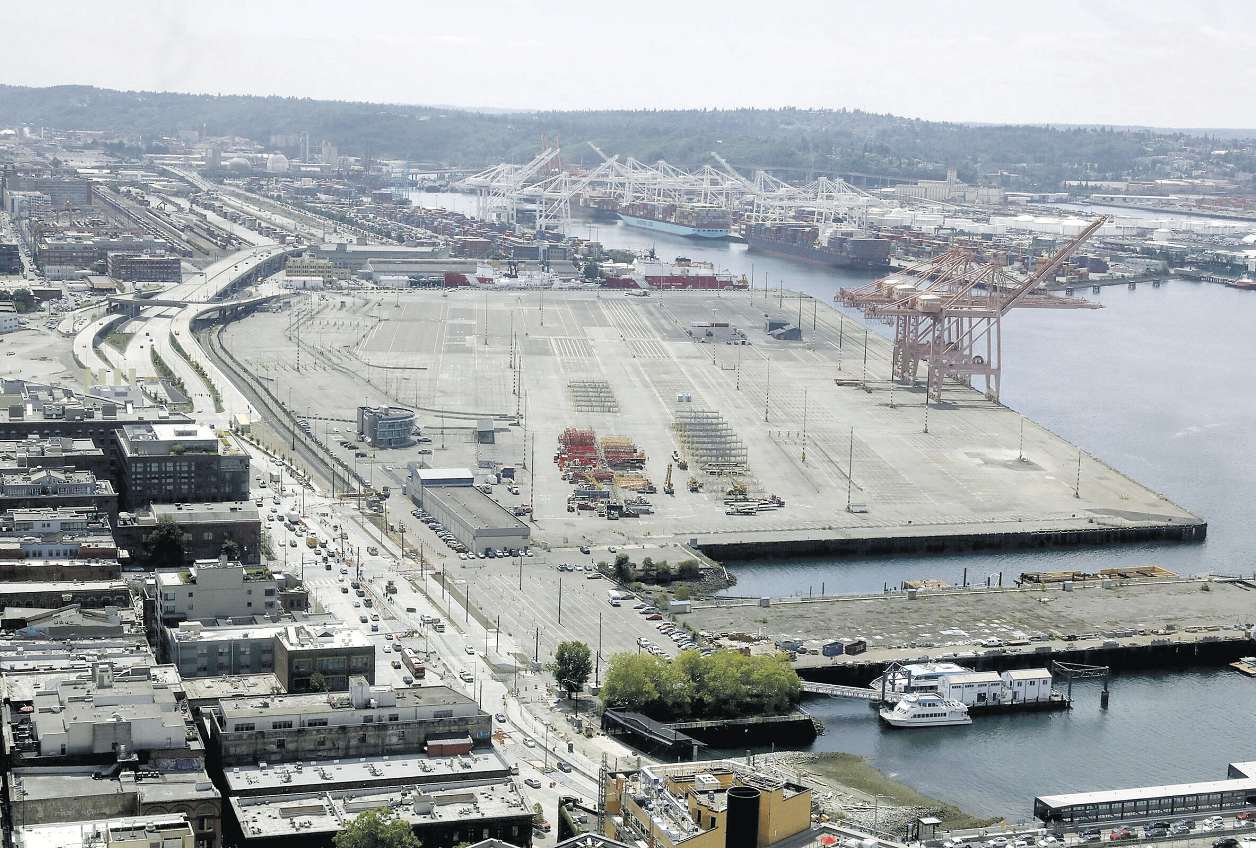
This view looking south from downtown Seattle is Northwest Seaport Alliance Terminal 46. Just beyond it is the U.S. Coast Guard station. The Coast Guard would like to redevelop its Seattle base and use part of Terminal 46.


Seattle’s Longshore workers move more than 25 million metric tons of cargo through the Port of Seattle each year. As a critical gateway for the global supply chain and for providing access to foreign markets for goods we make and grow here at home, it is no surprise that 40% of all jobs in our state are dependent on trade activity in some way, making Washington the most economically trade dependent state in the country.
Just as important, many trade-related jobs create economic opportunities for historically underserved communities and communities of color. As an example, Longshore workers are more diverse than the population as a whole, and we welcome folks seeking low-barrier pathways to economic prosperity.
These jobs and market access rest on billions of dollars in taxpayer and private investments to create the infrastructure necessary to support this trade activity.
Current plans to expand the U.S. Coast Guard’s Base Seattle put that investment, market access and our jobs at risk. Among the three alternatives that would displace containerized cargo capacity on the waterfront, one would take much of the Port of Seattle’s existing terminal capacity offline by consuming up to 54 acres of Terminal 46, and two others would occupy enough capacity on both T46 and/or T30 to make cargo operations there extremely inefficient. Worse, much of this irreplaceable infrastructure would be dedicated to non-water dependent uses like car parking.
Terminal 46 in particular has better access to Interstate 90 and Interstate 5 than any other marine port of entry in the Northwest Seaport Alliance network. The berths at T46 are naturally deep and easy to approach for larger docking vessels.
The two freight berths at T46 represent 25% of the Port of Seattle’s ship-berthing capacity.
In the past, T46 has also been examined for use as a cruise terminal, but the current three existing cruise berths are not yet at full capacity, so they still have room to grow. Cargo container ships will start calling at T46 early next year, representing the best use of that marine industrial land not just for International Longshore and Warehouse Union (ILWU) 19 workers, but for many Washingtonians who rely on the terminal to facilitate a variety of import and export activities.
T46 is currently being used as a United States Department of Agriculture storage yard by farmers in Eastern Washington and for overflow containers from other terminals. As an important food export facility, changes to these terminals could hit our state’s agricultural producers the hardest.
Inflationary pressures on food prices are driving record levels of international food insecurity. Now is not the time to impose higher costs on transporting food to an increasingly hungry planet by destroying fully functional and extremely limited berthing space.
Other land uses for this same area have been considered by city leaders, but wisely reoriented to preserve functionality of critical freight corridors in South Seattle. A plan for additional stadium development ultimately resulted in construction of the new Climate Pledge Arena, which has revitalized Lower Queen Anne and surrounding neighborhoods.
The best regional economic use of water-adjacent industrial lands with rail access continues to be marine cargo transport.
Every lost acre of terminal space results in 3,500 fewer containers being moved each year. As working families in Washington state also grapple with higher prices for basic subsistence goods, we must not fracture our local supply chain. If we want to help families fight inflation, we must protect our domestic link to global marketplaces still under pressure from the impacts of COVID-19 and global conflicts.
And we need to preserve our working waterfront to meet emerging needs. T46 has been examined as an option for offshore wind energy loading, unloading and assembly. Washington is poised to lead the world in clean energy investment, but only if we’re able to maintain capacity to transport clean energy components. We shouldn’t undercut Seattle’s ability to play a lead role in realizing a more sustainable energy future for all Washingtonians.
Our city’s working waterfront is foundational to our economic and cultural fabric.
It has been a catalyst for city prosperity in moments of optimism, and an important economic ballast during times of uncertainty. Even in the face of the global pandemic, which caused record spikes in demand, and devastating supply chain shortages, our port infrastructure continued to support waterfront industrial activities.
We support the Coast Guard’s national security mission, but we also support important domestic priorities of shared economic prosperity, living wage job opportunities for Washington families, and a vision for our city’s waterfront that strikes the right balance between these priorities.
To preserve what we have worked so hard to build we must ensure that any plans to redevelop Base Seattle results in no net loss of container cargo space at the Port of Seattle, that water adjacent land is used for water dependent activities and that we protect the jobs that working families need now more than ever.
Without major modifications, proposed alternatives for expanding Coast Guard Base Seattle would have unnecessarily negative impacts on irreplaceable freight infrastructure resulting in the permanent loss of these functions and the jobs associated with them. Longshore workers want to work with the Coast Guard, the Port of Seattle, the Northwest Seaport Alliance and other stakeholders to rethink and redesign the current proposals to find a better balance to meet all of our community’s needs.
Herald Ugles is the president of International Longshore and Warehouse Union Local 19.